Humans are adept at surviving life’s tragic truths. We don’t let certain realities occupy our moment-to-moment or day-to-day thoughts and activities lest they become our only reality. So, some of us shop for groceries thinking about the quality of the produce. We don’t focus on the fact that someone who sees our mere existence as a threat to be eliminated might show up to do just that. No. We think about the next item on the grocery list instead of the murderous act a white-supremacist terrorist committed against black shoppers at a Buffalo, NY supermarket.
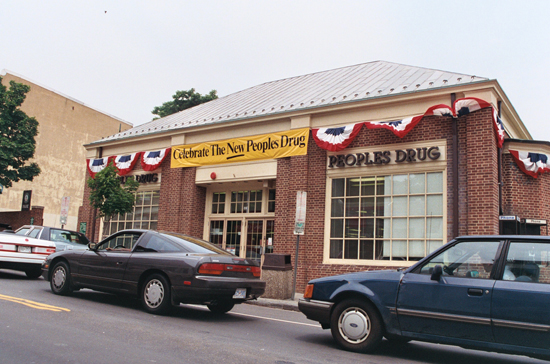
Buffalo, however, makes me think about the murder of my cousin, Thomas Williams, in June 1968, just two weeks before his high school graduation. An article in The Washington Post headlined, “Wilson Pupil Slain In Store Dispute,” is accompanied by Tommy’s photo and a truncated quote from his father which reads, “…a good boy…” According to the article, Tommy and a group of friends were entering the Peoples Drug Store in Georgetown when “two young men in front of the door bumped into” one of Tommy’s friends. “A brief altercation followed and [Tommy] broke it up.” When Tommy’s group left the store, the two men were waiting for them in the parking lot. One pulled a gun. Tommy and his friend, David, were shot. David survived.
That reporting did not sit well with some readers. Two letters to the editor noted the same thing: the failure to report that, between his friends and his killer, Tommy was the only black. A reader named Charles F. Schultz writes
Had these facts been included, the effect of the story would have been quite different. As it stands by your account, a black kid and his pals went to a party, then got into a brawl in a drug store that resulted in the kid being killed. (“Look Honey, now they’re on Wisconsin Avenue with all their shootin’ and violence”).
A reader named Mary Finch Hoyt points out that Tommy “…was the only Negro in a group of white, middle-class Northwest Washington students celebrating their graduation. White witnesses report that he was murdered by white assailants.” She goes on to write that “… whether or not the tragedy was racially inspired, full, realistic coverage might have helped bring into focus for Tommy’s friends and for black and white graduates in every part of our city the enormous problems which they inherit jointly…”
The story among family was that the murder was racially motivated. What I remember being said at the time was that the shooter saw the struggle between Tommy’s friends and another group of youths and had a problem with Tommy being black. I didn’t know if this was just automatically assumed or if the idea had been conveyed in some way by Tommy’s friends.
Further reporting provided new details. Tommy and his friends had gone to Georgetown from a party in Potomac. After picking up something to eat at the Little Tavern on Wisconsin Avenue, they went to the drug store at the corner of O. Street where Tommy and David brushed a youth they didn’t know who was with another group. After some words and a brief scuffle, the groups parted. A man with long red hair and beard who had walked up and begun talking to the other group followed Tommy and his friends. A fight started, and the man pointed a gun at Tommy, who is said to have “declared, ‘If you have a gun you had better use it.’” David took a bullet to the leg. Tommy took four bullets to the chest and upper arms. David was transported to Georgetown University Hospital. Tommy, a third-generation native of Tenleytown and a resident since birth of its then-tiny, ever-dwindling black community, was taken all the way across town to DC General.
On the afternoon of Tommy’s funeral, I left school during lunch hour to attend. My teachers and classmates were surprised to see me return before the end of the school day. I hadn’t planned to. I’d assumed that, after the church service, I’d go to the cemetery for the interment, back to the church for the repast, and then home, but that was not to be. At the end of the service, as his casket began to be wheeled down the center aisle, Tommy’s mother rose and lunged at it, uttering a scream so raw in its anguish it sounded inhuman. It caused a sorrow to course through me that I could not bear. I fled.
An article eleven days after Tommy’s murder states that a 29-year-old suspect was being sought in Miami, a man with a felony record involving a narcotics conviction in North Carolina (and a suspended sentence). He had been arrested in Miami for being a felon in possession of a gun. He was convicted but was told that sentencing would be withheld if he promised to stay out of Dade County. Miami police reported he had been there to open an office for the American Nazi Party.
Twenty-four days after Tommy’s murder, the Post reported the suspect’s arrest by the FBI in Providence, RI. Readers learn that he also was a former member of the Pagans, the notoriously violent outlaw motorcycle gang founded right next door in PG County whose members were known for their fascist and racist beliefs. An article written by Carl Bernstein, a Post staff writer at the time, says of the Pagans that they “tend to regard themselves as exemplars of a style of rugged individualism that has led to oppression and persecution by police and the press.”
During the trial two years later, the judge had to warn two associates of the defendant that “[t]he court is of the opinion that you’re trying to run this court” after one of them made threats in the courtroom against a witness.
On the third day of trial, Tommy’s killer decided to plead guilty to manslaughter, assault with intent to kill, and carrying a dangerous weapon, saying that he “had hoped for a real trial, a search for the truth of the matter…was I guilty of a wrong act or was I protecting myself?”
We go about our lives, but life reminds us of the adage about things changing while remaining the same. A drug store in Georgetown one day, a supermarket in Buffalo another.
 14isgreaterthan10.com