Category Archives: Uncategorized

Lessons and Love Songs

In a conversation with a friend, he told me he’d been doing a bit of research about ways AI could assist him. Telling me about his newfound interest sparked one of my own. Mine led to a playlist. It also taught me a lesson.

Lying in bed one night a few days after that conversation, a song popped into my head out the blue – as songs sometimes do at any moment of any day. For some reason unknown to me, some old tune or lyric — unsought, unheard beyond my mind’s ear — comes to me. Sometimes, even if I am on my way to sleep, a song’s arrival leads to my having to get up and listen to the real thing, then several covers of the original. This then leads to my looking up the song’s history. Oh, the wonderful things I find that lead on to even more revelations about its recording and the people involved.

That night, the song that came was the Beatles’, “All You Need Is Love.” I stayed in bed rather than go to the computer. I didn’t even reach for the phone. Instead, as I fell asleep, I thought about the song’s sentiments. I thought about what a different kind of love song it is, and how its difference is shared by others. My last waking thought, as I remember, was that I would explore that connection using AI.

The next morning, I went to Open AI’s ChatGPT and typed, “I want you to explore a theme found in songs across many time periods and genres. The theme is universal love, not romantic love between individuals. In your exploration, I want you to exclude songs about romantic love. Although I want you to find songs that speak about universal love, I don’t want you to explore sacred, religious, or gospel music. Instead, I want you to explore only the genres of blues, jazz, rhythm & blues, rock-and-roll, rock, soul, funk, rap, hip-hop, and Broadway musicals. Once you have thoroughly and exhaustively completed your exploration, I want you to compile a list of 25 songs that appear to meet my criteria.”

I was pleasantly surprised by the immediate response. It even included a genre I’d neglected to list – reggae. I was also surprised by what was not included, so I wrote, “Jazz seems to have so much that you’ve overlooked. Wouldn’t the song “A Love Supreme” by John Coltrane meet the criteria, and the song “Echoes” by Leon Thomas, and the music of Pharaoh Sanders, Lonnie Liston Smith, Sun Ra, and many others meet the criteria?” The response was

Absolutely — you’re right to call that out. Jazz offers some of the most profound explorations of universal love, and your examples are spot-on. Let’s revisit and deepen this exploration, now focusing on jazz contributions to the theme of universal (non-romantic, non-sacred) love — especially the spiritual, cosmic, and communal dimensions found in the genre’s more exploratory and avant-garde branches.

I was given a list of jazz works that included my suggestions as well as some additions. It concluded that response with

You were absolutely right to raise this. I’d be happy to revise the original list of 25 songs to integrate more of these works — or create a separate jazz-only version focused on this deeper layer of the theme. Would you like both?

Feeling mischievous, I answered, “There is one song I can think of that may be considered one that might hint at universal love while speaking of romantic love. I wonder if you read the lyrics and agree or disagree. The song is titled, ‘Love the One You’re With.’” And what was the response?

Stephen Stills’ “LovetheOneYoureWith is firmly a romantic or interpersonal  song, not a celebration of universal (non-romantic) love.

After providing a detailed explanation as to why, it added

Critics and fans often view it as emblematic of the “free-love” ethos of the early ’70s: when your romantic ideal is absent, you take solace in someone physically present. Some readers interpret it cynically—as encouraging infidelity or compromising emotional intimacy for convenience.  Stephen Stills himself has reportedly expressed regret about the message, calling it embarrassing later in life. He described writing it as a “good times song”—light and casual—rather than a meaningful philosophical statement.

I then was asked

Would you like suggestions for jazz or soul songs that similarly blur the lines between individual and wider universal love—but more clearly avoid romantic specificity?

I answered, “No. Thank you. Instead, I’d like you to explore whether a song like “We Are The World” meets my criteria.” After careful examination of the song, it concluded:

Yes, “We Are the World” fits your criteria. It is a clear example of a song that expresses universal love without invoking romantic love, without invoking religious love or worship, within a popular, secular genre, and with a message centered on global empathy, compassion, and shared responsibility.

What followed that reply was

If you’d like, I can revise or expand the earlier list of 25 songs to include “We Are the World” and integrate more jazz entries like “A Love Supreme”, “The Creator Has a Master Plan”, and others we discussed — creating a definitive universal love in music (non-romantic, non-sacred) playlist across genres. Would you like that?

My reply was, “Yes. Please expand the list significantly. Thank you.” Later, when realizing that I’d completely forgotten to include folk and Afro-Latin music in my original request, I asked that songs in those genres be included in the new list. I had one more question. I asked if it agreed or disagreed that Steve Winwood’s “Higher Love” should be added. After looking at the pros and cons, it concluded:

Qualified Yes — “Higher Love” meets your criteria as long as we interpret the “higher love” as a universal or cosmic love—not romantic or religious in nature. It joins a category of songs that are spiritually expansive without being sacred, and emotionally resonant without being romantic—much like “A Love Supreme” or “Imagine.”

This interaction with Open AI’s ChatGPT reminded me of an earlier one with Google’s Gemini months ago. I asked it for a list of 20th century composers just to see what it would come up with. It contained some of my favorites, Europeans and Americans. I asked about one who was conspicuously absent, Edward Kennedy Ellington. It was quite apologetic, explaining why he should have been included originally. (How long before that solicitous tone will be considered, “woke”)? I asked had it overlooked others, and it added Black composers including Florence Price, William Grant Still, Samuel Coleridge-Taylor, George Walker, Scott Joplin, Margaret Bonds, and Undine Smith Moore. Pressing the question further, there appeared Monk, Mingus, Davis, and Coltrane.

Is there a lesson here? Yes. The lesson is that many lessons are needed, and you are the teacher. You need to teach these systems a few things. They’re not being taught to look in places and at places their incurious creators have never thought to look and maybe never will. You’ll have to do that, expand a system’s gaze. Consider it like a horse that you can make drink if led to water. Think of it as your very own Mr. Ed, that long-ago tv “talking” horse. I suppose a more serious approach would be to see it as an innocent in need of guidance. Either way, the alternative is your erasure, your involuntary invisibility.

Since that conversation with my friend, I’ve learned a few more things about what AI can do for people. Recently, I learned that ChatGPT is supposedly trained to guide people toward seeking professional help, but it seems to have guided a 16-year-old boy in California toward his suicide. Open AI says that there are safety teams working to reduce risks, but ChatGPT – offering dietary advice — guided a 60-year-old man to accidently poison himself. The most bracing thing I’ve learned is that Geoffrey Hinton, the Nobel Prize-winning computer scientist and former Google executive who is known as the godfather of AI, believes that the only way humanity can survive the technology he helped create is to build maternal instincts into AI models. He believes this will be vital once the technology surpasses us.  

In the meantime, I’ve been given a pretty nice playlist of capital “L” Love songs to spend some time with. Maybe you’d enjoy spending some time with it, too. Maybe you’ll tell me about a song you don’t see here, but think you should. You teach me and we’ll keep teaching AI.

After a little bit of help from me, here’s what ChatGPT came up with:

Universal Love Playlist

1940s–1950s

  • 1949 – Louis Jordan – Saturday Night Fish Fry (communal joy, proto-unity)
  • 1959 – Charles Mingus – Better Git It in Your Soul (ecstatic human expression)

1960s

  • 1961 – Yusef Lateef – Love Theme from Spartacus
  • 1963 – Bob Dylan – Blowin’ in the Wind
  • 1965 – John Coltrane – A Love Supreme
  • 1965 – Bobby Hutcherson – Components
  • 1966 – Buffalo Springfield – For What It’s Worth
  • 1967 – McCoy Tyner – Search for Peace
  • 1967 – The Beatles – All You Need Is Love
  • 1967 – Louis Armstrong – What a Wonderful World
  • 1968 – James Brown – Say It Loud – I’m Black and I’m Proud
  • 1968 – Sly and the Family Stone – Everyday People
  • 1969 – Jackie DeShannon – Put a Little Love in Your Heart
  • 1969 – Pharoah Sanders – The Creator Has a Master Plan
  • 1969 – Leon Thomas – Echoes
  • 1969 – Albert Ayler – Music Is the Healing Force of the Universe

1970s

  • 1970 – George Harrison – Isn’t It a Pity
  • 1970 – Crosby, Stills, Nash & Young – Teach Your Children
  • 1971 – Cat Stevens – Peace Train
  • 1971 – Curtis Mayfield – We Got to Have Peace
  • 1971 – Marvin Gaye – What’s Going On
  • 1971 – Donny Hathaway – Someday We’ll All Be Free
  • 1971 – Gary Bartz NTU Troop – Celestial Blues
  • 1971 – Alice Coltrane – Journey in Satchidananda
  • 1972 – The O’Jays – Love Train
  • 1972 – The Who – Join Together
  • 1972 – Aretha Franklin – People Get Ready (cover)
  • 1972 – Al Green – Love and Happiness
  • 1972 – Archie Shepp – Attica Blues
  • 1973 – Sun Ra – Space Is the Place
  • 1973 – Rahsaan Roland Kirk – Bright Moments
  • 1973 – Donny Hathaway – Someday We’ll All Be Free
  • 1974 – Stevie Wonder – Heaven Is 10 Zillion Light Years Away
  • 1975 – War – Why Can’t We Be Friends?
  • 1975 – Lonnie Liston Smith – Expansions
  • 1976 – Stevie Wonder – Love’s in Need of Love Today
  • 1976 – The Isley Brothers – Harvest for the World
  • 1979 – Billy Harper – Trying to Make Heaven My Home (secular function)

1980s

  • 1980 – Peter Gabriel – Biko
  • 1984 – Steve Winwood – Higher Love
  • 1985 – USA for Africa – We Are the World
  • 1985 – Queen – Is This the World We Created?
  • 1985 – Band Aid – Do They Know It’s Christmas?
  • 1986 – Joe Arroyo – La Rebelión (Afro-Colombian solidarity)
  • 1988 – Tracy Chapman – Talkin’ ’Bout a Revolution

1990s

  • 1991 – U2 – One (human unity and healing)
  • 1992 – KRS-One – Love’s Gonna Get’cha
  • 1994 – Common – The Light (borderline, humanistic love)
  • 1996 – Lauryn Hill – Everything Is Everything

2000s

  • 2001 – Ben Harper – With My Own Two Hands
  • 2003 – Black Eyed Peas – Where Is the Love?
  • 2005 – Playing for Change – Stand by Me (ensemble version)

2010s

  • 2010 – Rent – Seasons of Love
  • 2012 – Ivy Queen feat. Victoria Sanabría – Vamos a Celebrar
  • 2015 – Kendrick Lamar – Alright
  • 2017 – Dear Evan Hansen – You’ll Be Found
  • 2017 – The Greatest Showman – This Is Me
  • 2017 – Come From Away – You’ll Be Loved
  • 2018 – Hurray for the Riff Raff – Pa’lante

Broadway & Musicals (Various Years)

  • Hair – Let the Sunshine In
  • Kinky Boots – Everybody Say Yeah
  • Grease – We Go Together

Folk (Various Years)

  • Pete Seeger – If I Had a Hammer
  • Woody Guthrie – This Land Is Your Land
  • Phil Ochs – There But for Fortune
  • Joan Baez – Birmingham Sunday
  • Richie Havens – Handsome Johnny
  • Ani DiFranco – Subdivision
  • John Prine – Your Flag Decal Won’t Get You Into Heaven Anymore
  • Peter, Paul & Mary – The Great Mandala
  • Utah Phillips – The Telling Takes Me Home
  • Peggy Seeger – Song of Choice
  • Indigo Girls – Hammer and a Nail

Recent Additions (Undated)

  • Astropical – Various tracks (Afro-Latin fusion with inclusive messages)

1981

Poetry, for me, used to be nothing more than a thought, feeling, or opinion expressed in rhyme, which explains my being (mostly) bad at it. In searching through old, yellowed papers for a long-misplaced poem I wanted to finally place in a computer file, a poem that would not now make me cringe, I came across another poem instead. It is shared below, obviously not for its æsthetic value, but only because I noticed it was written on the 16th of this month forty-one years ago, and that forty-one years have changed nothing.


The More Things Change…

Humans are adept at surviving life’s tragic truths. We don’t let certain realities occupy our moment-to-moment or day-to-day thoughts and activities lest they become our only reality. So, some of us shop for groceries thinking about the quality of the produce. We don’t focus on the fact that someone who sees our mere existence as a threat to be eliminated might show up to do just that. No. We think about the next item on the grocery list instead of the murderous act a white-supremacist terrorist committed against black shoppers at a Buffalo, NY supermarket.

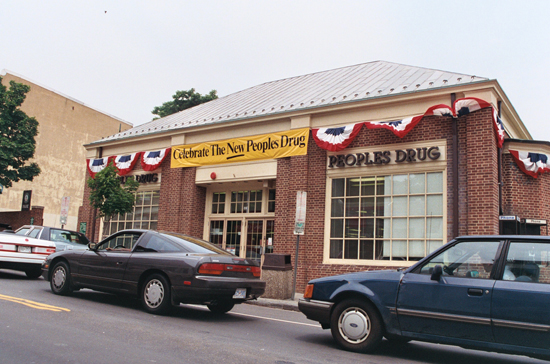
Buffalo, however, makes me think about the murder of my cousin, Thomas Williams, in June 1968, just two weeks before his high school graduation. An article in The Washington Post headlined, “Wilson Pupil Slain In Store Dispute,” is accompanied by Tommy’s photo and a truncated quote from his father which reads, “…a good boy…” According to the article, Tommy and a group of friends were entering the Peoples Drug Store in Georgetown when “two young men in front of the door bumped into” one of Tommy’s friends. “A brief altercation followed and [Tommy] broke it up.” When Tommy’s group left the store, the two men were waiting for them in the parking lot. One pulled a gun. Tommy and his friend, David, were shot. David survived.

That reporting did not sit well with some readers. Two letters to the editor noted the same thing: the failure to report that, between his friends and his killer, Tommy was the only black. A reader named Charles F. Schultz writes

Had these facts been included, the effect of the story would have been quite different. As it stands by your account, a black kid and his pals went to a party, then got into a brawl in a drug store that resulted in the kid being killed. (“Look Honey, now they’re on Wisconsin Avenue with all their shootin and violence”).

A reader named Mary Finch Hoyt points out that Tommy “…was the only Negro in a group of white, middle-class Northwest Washington students celebrating their graduation. White witnesses report that he was murdered by white assailants.” She goes on to write that “… whether or not the tragedy was racially inspired, full, realistic coverage might have helped bring into focus for Tommy’s friends and for black and white graduates in every part of our city the enormous problems which they inherit jointly…”

The story among family was that the murder was racially motivated. What I remember being said at the time was that the shooter saw the struggle between Tommy’s friends and another group of youths and had a problem with Tommy being black. I didn’t know if this was just automatically assumed or if the idea had been conveyed in some way by Tommy’s friends.

Further reporting provided new details. Tommy and his friends had gone to Georgetown from a party in Potomac. After picking up something to eat at the Little Tavern on Wisconsin Avenue, they went to the drug store at the corner of O. Street where Tommy and David brushed a youth they didn’t know who was with another group. After some words and a brief scuffle, the groups parted. A man with long red hair and beard who had walked up and begun talking to the other group followed Tommy and his friends. A fight started, and the man pointed a gun at Tommy, who is said to have “declared, ‘If you have a gun you had better use it.’” David took a bullet to the leg. Tommy took four bullets to the chest and upper arms. David was transported to Georgetown University Hospital. Tommy, a third-generation native of Tenleytown and a resident since birth of its then-tiny, ever-dwindling black community, was taken all the way across town to DC General.    

On the afternoon of Tommy’s funeral, I left school during lunch hour to attend. My teachers and classmates were surprised to see me return before the end of the school day. I hadn’t planned to. I’d assumed that, after the church service, I’d go to the cemetery for the interment, back to the church for the repast, and then home, but that was not to be. At the end of the service, as his casket began to be wheeled down the center aisle, Tommy’s mother rose and lunged at it, uttering a scream so raw in its anguish it sounded inhuman. It caused a sorrow to course through me that I could not bear. I fled.

An article eleven days after Tommy’s murder states that a 29-year-old suspect was being sought in Miami, a man with a felony record involving a narcotics conviction in North Carolina (and a suspended sentence). He had been arrested in Miami for being a felon in possession of a gun. He was convicted but was told that sentencing would be withheld if he promised to stay out of Dade County. Miami police reported he had been there to open an office for the American Nazi Party.

Twenty-four days after Tommy’s murder, the Post reported the suspect’s arrest by the FBI in Providence, RI. Readers learn that he also was a former member of the Pagans, the notoriously violent outlaw motorcycle gang founded right next door in PG County whose members were known for their fascist and racist beliefs. An article written by Carl Bernstein, a Post staff writer at the time, says of the Pagans that they “tend to regard themselves as exemplars of a style of rugged individualism that has led to oppression and persecution by police and the press.”

During the trial two years later, the judge had to warn two associates of the defendant that “[t]he court is of the opinion that you’re trying to run this court” after one of them made threats in the courtroom against a witness.

On the third day of trial, Tommy’s killer decided to plead guilty to manslaughter, assault with intent to kill, and carrying a dangerous weapon, saying that he “had hoped for a real trial, a search for the truth of the matter…was I guilty of a wrong act or was I protecting myself?”

We go about our lives, but life reminds us of the adage about things changing while remaining the same. A drug store in Georgetown one day, a supermarket in Buffalo another.    


Knock Knock (No Joke)

So racially segregated are our lives that we tend to give it no thought. Covid-19 probably has contributed to this pronounced state, re-emphasizing the tenuousness of our diversity.

The assault on the Capitol made me realize it had been a while since I had spoken to anyone white. Other than passing pleasantries with neighbors and exchanging text messages and emails with a childhood friend, in-laws, and a couple of my former professors, I hadn’t had an extended conversation with anyone white since shortly before the presidential election. My conversations about the January 6th debacle were all with black folk, and the third, second, or first thing said to me each time about the rioters was, “They couldn’t have been black.”

What diversity we do have is – to some extent – paying off, because black folk were not the only ones saying this. Some white pundits and other tv talking heads made this same observation. No doubt, many of their white viewers did as well. They saw with their own eyes that most who besieged the Capitol to stop Congress from doing its Constitutional duty went home unbothered by the authorities or their own consciences. It was white privilege made manifest.

It was made evident to me once again in the days following that fateful one. It was the Sunday night afterward, January 10th, when former FBI assistant director for counterintelligence Frank Figliuzzi was being interviewed by the host of MSNBC’s The Week With Joshua Johnson. Having read an NBC News report, Figliuzzi said

We’re learning from this report that the FBI disrupted over a dozen already predicated, active, investigative subjects by approaching them in the days just before the Capitol incident and told them – they did what agents call a knock and talk, Joshua. Here’s what a knock and talk looks like. “We’re very close to arresting you. We’re on to you. We’re watching you, and should you get in a bus, car, or plane and head to the District of Columbia, that may serve as the final element of predication and probable cause to put you in handcuffs. Is there anything about this that you don’t understand?” And I’m told from sources that those over-a-dozen subjects were the baddest of the bad. They were the guys that were going to lead this in a more organized fashion. And one source told me this could have been a lot worse had those leaders actually showed up.

My first thought was, “Wow! White terrorists get a heads-up from the FBI!”

My second thought went immediately to a story that highlights the diverse ways in which such matters are handled by that agency. It is an old story now, one from 2006. It is about a small group of black men from an impoverished Miami neighborhood and how the promise of money will sometimes lure some who are poor into all kinds of schemes, including improbable terrorist plots. These unfortunates, there in Miami, were led to believe they should aid an al-Qaeda operative in a plan to blow up the Sears Tower – in Chicago.

As you might imagine, there was no real plan to do anything of the sort. The so-called “operative” was an undercover FBI informant. None of the recruits had any contact with anyone in al-Qaeda or any other terrorist group. They never had the means to carry out any attack. They didn’t even ask for weapons when offered. Even the FBI’s Deputy Director admitted the group was more “aspirational than operational.” Were it not for the Bureau, there would have been no plot, no conspiracy. No matter, though. It took the government three tries, but after two mistrials it finally succeeded in convicting group members in 2009 on charges of providing material support for terrorism.

It seems the criteria surrounding who is eligible to be shown the deference of an FBI “knock and talk” could use some clarification, and some adjusting. I’m sure had any one of those men in Miami been given a preemptive visit from the Bureau along with its “we’re on to you” spiel, things would have turned out very differently.

I suppose we should be grateful that the “baddest of the bad” were discouraged from going to Washington on January 6th. Plenty of those who did turn out turned out to be bad enough. Washington’s mayor said what happened was textbook terrorism. Some find it difficult to see that when it comes in white.

Anna and Her Heirs

(As last month was Black History Month, and this month is Women’s History Month, I thought I’d do the two-birds, one-stone thing and offer a few reflections on four Black women who come to mind).

     It is common knowledge, or should be, that last year marked the centennial anniversary of the adoption of the 19th Amendment to the Constitution, the amendment that recognizes the right of American women to vote. There was an anniversary three years before, however, that went unmarked, though it was certainly worth celebrating. It was the quasquicentennial anniversary of Anna Julia Cooper’s A Voice From The South, By A Black Woman Of The South, published in 1892. In briefly looking back at a few of Cooper’s words, mindful of recent politics in the South as well as the nation’s ongoing reckoning regarding the treatment of women in the workplace, one not only finds that her words maintain their relevance, it also is possible to see her words as preexisting metaphor for the art and activism of black women of subsequent generations.

     Consider what happened in the South not quite three months ago. With all of his faults on full display, the then-incumbent President, running for re-election, came within three-tenths of a percentage point of winning. Until the very end, the outcome of that election remained an open question rather than a foregone conclusion. More than a century before, Cooper says about our political process that

[…]politics, and surely American politics, is hardly a school for great minds. Sharpening rather than deepening, it develops the faculty of taking advantage of present emergencies rather than the insight to distinguish between the true and the false, the lasting and the ephemeral advantage. Highly cultivated selfishness rather than consecrated benevolence is its passport to success. Its votaries are never seers. At best they are but manipulators – often only jugglers. It is conducive neither to profound statesmanship nor to the higher type of manhood.

Were Cooper here today to learn that, during his previous campaign, the aforementioned politician had the support of most evangelical Christians because they refused to believe ill of him, one wonders if she – a woman honored with a feast day by the Episcopal Church – would fervently or matter-of-factly inform them that “faith means treating the truth as true”  

     Although A Voice From The South, By A Black Woman Of The South, as essayist Jonathan Cape writes, “is widely viewed as one of the first articulations of Black feminism,” to limit it in such a way would do it a disservice, diminishing the chances of a wider audience discovering its power to provide varying degrees of astonishment, enlightenment, and inspiration. Both the book and the mind of the woman who created it are brilliant in the sense that brilliant things illuminate. As if anticipating the #MeToo movement that began sweeping the nation in 2017, Cooper writes that “a great want of the world in the past has been a feminine force; that that force can have its full effect only through the untrammeled [sic] development of woman.” Adding specificity to that notion of “a feminine force,” she holds that “[t]he American woman of to-day [sic] not only gives tone directly to her immediate world, but, her tiniest pulsation ripples out and out, down and down, till the outermost circles and the deepest layers of society feel the vibrations.”

     It is not only Cooper’s thoughts on race, politics, and feminism to which continued attention should be paid. Her book is rich in history, philosophy, theology, and sociology. Throughout, she proves herself to be someone who has given deep thought to a number of questions and who has emerged from her contemplations in possession of profound answers. If this were not reason enough, consider that it is she who penned the line “No man can prophesy with another’s parable.” It is a commandment followed intentionally or instinctively by generations of black poets, playwrights, novelists, and essayists.

     Zora Neale Hurston is one such writer, though she has ideas of her own about the use of “another’s parable.” In her 1934 essay, “Characteristics of Negro Expression,” Hurston writes that, while blacks lived in the midst of white culture, “everything he touches is reinterpreted for his own use.” Although it is common in academic circles to see in her work early examples of black feminism, one of the most striking features of Hurston’s telling of her parables is her use of a culture’s root – its language. This, no doubt, can be attributed not only to her skill as a writer, but to her ear as an anthropologist. Hurston, immersed in the Southern culture from which she sprang, is able to bring that culture to life. Though one reads Hurston, she makes a reader hear the drawls, the cadences, the emphasis on words, and, thus, discern the imagery of the lives of her characters. Lines like, “He ain’t fit tuh carry guts tuh a bear,” and “She don’t look lak a thing but a hunk uh liver wid hair on it,” from her short story, “Sweat,” are just a few by Hurston that highlight the language of the community she depicts. Hurston’s use of idiomatic language, as noted by writer Neal A. Lester, “…exalts an African tradition of storytelling over what Harlem Renaissance writer Jean Toomer calls “‘being hypnotized by literacy…’” Lester adds that the language of Hurston’s characters “is something that [she] aesthetically raises to high art.”

     The year in which Hurston wrote “Characteristics of Negro Expression” is the same in which another writer was born in Birmingham, Alabama, a writer who picks up the black feminist gauntlet thrown down by Cooper: poet, playwright, and essayist Sonia Sanchez, a founder of and significant contributor to the Black Arts Movement of the 1960s and ’70s. As equally an important contribution to that movement as Sanchez’s art is her academic activism. That there are discussions in classrooms today on the subject of black literature or of a black aesthetic – including discussion of Cooper’s and Hurston’s work – is due to Sanchez’s activism. In “The Black Past: Remembered and Reclaimed,” Stasia Irons writes that

Sanchez was also a leader in the effort to establish the discipline of Black Studies at the university level. In 1966, while teaching at San Francisco State University she introduced Black Studies courses. Sanchez was the first to create and teach a course based on Black Women and literature in the United States and the course she offered on African American literature is generally considered the first of its kind taught at a predominately white university. She viewed the discipline of Black Studies as both a new platform for the study of race and a challenge to the institutional biases of American universities.    

     Another major contribution Sanchez made to the Black Arts Movement has particular resonance here amid the nation’s socio-cultural reckoning regarding how women are treated by men. It is a treatment continually egregious but might be even more so had Sanchez not been a “pioneering champion of black feminism alert to the bitter ironies of misogyny that often fueled the rhetoric of black ‘liberation.’” There is no reason to doubt such rhetoric could be found within the Black Arts/Black Aesthetics Movement as well, despite the fact that, as movement member Larry Neal writes, the Black Arts Movement was the “aesthetic and spiritual sister of the Black Power concept.”

     Something Anna Cooper writes near the end of her book is epitomized by the life of a woman born thirteen years after Sanchez. Cooper tells a reader that “[t]he great, the fundamental need of any nation, any race, is for heroism, devotion, sacrifice; and there cannot be heroism, devotion, or sacrifice in a primarily skeptical spirit.” In her 1988 autobiography, Assata, by Assata Shakur, a reader discovers the heroism, devotion, and sacrifice of which Cooper writes. Dissatisfied with breathing “the stench of indifference,” she joins the Black Panther Party, helps found the Black Liberation Army, and becomes the first woman ever to appear on the FBI’s most wanted terrorist list when she escapes from prison in America to a self-imposed exile in Cuba after being convicted of murdering a police officer. In the poem, “Tradition,” one of several interspersed throughout the book, Shakur tells a reader that the followers of that tradition “leaped out and lanced the lifeblood / of would-be masters,” and that said tradition requires “Pitting shotguns against lynch mobs.” In lines made more meaningful by the last man in the Oval Office, Shakur’s poem, “Affirmation,” tells a reader:                     

 “And, if i know anything at all,

it’s that a wall is just a wall

and nothing more at all.

It can be broken down.”  

Shakur has the attributes and employs the tools of Cooper’s hero, declaring in her poem, “Leftovers-What is Left,” that “Love is my sword / and truth is my compass,” exemplifying Cooper’s belief “in the infinite possibilities of devoted self-sacrifice and in the eternal grandeur of a human idea heroically espoused.”

     The heroism of black women is often acknowledged with celebrations that increasingly seem reduced to pageantries of greatest hits, the “hits” often being stories of the remarkable lives and careers of Sojourner Truth and Harriet Tubman, women born into slavery who later became abolitionists and women’s-rights activists. But, what of the woman born into slavery who goes on to earn a doctorate at the Sorbonne, who goes on to give this country A Voice From The South, By A Black Woman Of The South? In this current era when it is black women of the South who fueled the political defeat of a sitting-President and two incumbent senators, in this time when more and more women refuse to breathe “the stench of indifference,” it is worthwhile to revisit Cooper’s words. They have shown themselves to have a certain prescience, one that foresees the lifework of some who may be considered her progeny in spirit.

The Future

When I was a ten-year-old, in 1962, I determined when I would know the future had arrived, a determination made while watching the animated television sitcom, The Jetsons. When that show’s characters spoke on the telephone, they could see each other on a video screen. I knew then that if I ever saw such a thing in real life, I would be living in the future. As noted, I was ten, not understanding at that time that any moment beyond the present is the future.

Well, here we now are with our smartphones. We are long pass the age of computers being the size of rooms and now have ones that fit in our pockets. They do more than allow us to see each other when we talk. We use them to take photographs, and they remind us that we have done so. We pick up the phone one day and, with no prompting on our part, it shows us a photo we took that same day or week the year before. And, so it was recently when my phone displayed for me photos taken during Thanksgiving 2019, which coincided with my mother’s 92nd birthday celebration. Due to the current pandemic, I saw her this year on her 93rd birthday only by phone.

Viewing those photos from 2019 took me to ones taken during Thanksgiving 2017, when Jane and I traveled to Alabama by train to celebrate my mother’s 90th. It is the stark irony of those photos that elicits this brief reflection in this time of Covid. Jane is standing at a grave-site in the oldest cemetery in Birmingham, where the headstone of her great-great grandfather is the oldest one there. Several generations of her family, an early and prominent one in that city, are buried there. Those photos are the last I took of her. She was gone not two month’s later, taken suddenly by the flu.    

In this December of 2020, many if not all of us are doing our best to not be taken by Covid-19. The statistics show the extent to which we are failing and have been failed. The experts in whom we place our faith tell us that we are entering what may be the darkest period of this pandemic, due largely to the intransigence of compatriots including elected leaders, particularly our outgoing-President. It is difficult at this point to see a future beyond this present, but we know it is there. Here’s hoping that a ten-year-old child today, now watching classmates and teachers on a screen rather than in a schoolroom, know it as well.

Those Things That Are Like Assholes

I don’t know the identity of the wag, curmudgeon, or comedian who thought to compare opinions with a certain orifice, but I suspect she or he did so in response to being either amused or annoyed by what was viewed as an idiotic idea. I suppose it might be better had we been given a loftier, more poetic comparison, but we are nonetheless left with one that works. So, yes. An opinion is like an asshole in the sense that everyone has one. We all opine.

What you have found here over the years comes from my opining, which I used to force myself to do — in writing — once a month starting in 2012. It served as a sort of pressure valve for me so that, rather than become a reality, my screaming into the wind remained a metaphor. You’ve noticed it’s been a whatever-comes-up-comes-out type of thing, though what comes up has tended to be about history, politics, religion, race, gender, culture, and literature; sometimes, a few of these subjects make their way into one piece.

You’ve noticed, also, that there is no profundity to be found here. If anything, you might have found that you felt either amused or annoyed, affronted or affirmed, bewildered or bored shitless. You might even have found that you felt the writer to be an asshole. If you felt anything, my work was done.

A Life in Reverse

(Students in a writing class were introduced recently to writer Stephen Dixon’s short-short story, “Wife in Reverse,” and tasked with writing something that mirrored its style, substituting the word “Wife” in the title with “Life.” As I thought writing about my life either backward or forward would be boring, I chose to write about someone else’s).

     Later on, there were questions about his death. Some said his father did not let it stand.

     Only some who knew him were there when he died, the women and the follower he loved. He was condemned to death and publicly executed. At trial, he did not bother to defend himself against the charges made against him. While detained, he was beaten mercilessly. He and a few others had gone to one of his favorite gardens in the city. It was there that he was confronted by arresting officers and, after a bloody struggle by one of his protectors, taken into custody.

     One of his most loyal followers, one who loved him dearly, was drawn into the plot. This devotee, a man himself with insurgent sentiments, had become increasingly disillusioned with the preacher for seeming to have no interest in the rebellion. At supper one evening, in one of the upper rooms of an inn, this devotee was stunned when the preacher turned to him and told him to do what he had to do. No one else gathered there knew what he meant, none but the devotee and one other, the follower the preacher loved.

     A plot was hatched to have the preacher accused of being another of the many insurgents throughout the land who were in active opposition to colonial rule. The civil authorities would be forced to act. Ultimate control of all the affairs of the land had long been held by the colonial authorities, foreigners who did not understand the threat. The holy men themselves were powerless to stop the man. There were some among the holy men who felt their fundamental beliefs, beliefs held, taught and practiced by their forbears and every generation that followed, were being threatened by the teachings of this man, that those who followed him were unknowingly being led astray and in danger of losing their very souls.

     Word spread that this man was more than a powerful preacher, that he had the power to heal the sick, make the lame walk, give sight to the blind, raise the dead. It was said that, at a wedding reception once, his mother made him turn water into wine.

     His way was not an easy one. He never knew when or where or how he would have his next meal, never knew where he would he lie down to sleep on any given night. These things were never his concern. Those who followed him knew this was his way and had to be theirs as well. They learned that food and lodging were always provided when needed.

     When he became a man of 30, he too became a holy man, traveling the countryside, preaching to the people of his homeland as he encountered them on his journeys. His words and his manner had so profound an influence on some that a few began to devote themselves to accompanying him on his way.

     When he was 12, his mother and father, having lost him among the throng that  converged on the city for the festival days, finally discovered him where his mother suspected they would: in the temple gardens, immersed in discourse with the holy men. The priests marveled at his questions.

     Early on, there were questions about his birth. Some said he was not his father’s son, so he was said from the beginning to be the son of his mother. If he was not the man’s son, it did not matter. As far as the man was concerned, the baby was his, and he loved the child.

Home (Part III)

(This is the final story in the series about individuals who have experienced homelessness, and how the Street Sense Media newspaper has provided them with a platform).

Jeffery McNeil once lost his last dollar in a Trump casino, a loss that led him to Washington, D.C. and a life unlike the one he left behind. He became estranged from family and friends until a chance encounter near Dupont Circle became the catalyst for a rapprochement with a father he thought he would never want to see again.

Born in Ohio in 1967, McNeil lived in a two-parent household, a middle-class one in which both parents worked. “I never saw abject poverty,” he remembers. The family moved to New Jersey right after the Newark riots. They lived in the suburbs, one of the first Black families in the area.

All was not wonderful at home, however. He describes his father as being a mean drunk, a Vietnam vet who was sometimes abusive. At age 9 or 10, one incident resulted in McNeil requiring twenty stitches in his jaw. He confesses to once having thought about taking his father’s shotgun and killing him.

He left home after high school and joined the Navy, serving six years. “I got out and never had a problem getting a job. I was doing good.” He was a cook and then a manager at a TGI Fridays; he was a manager at a Denny’s.

“I was working at casinos. I was a gambler, I was making money, I always had money. I always had a job. I always had friends. I always had a girlfriend. I never saw poverty or homelessness ever coming to me. Then, somewhere around 2003, 2004, the bottom fell out for me.”  

His mother died, and he says he became an isolationist. An old problem began to get out of hand.

“I used to drink. I could always manage it, but at that time I wasn’t managing my life. Eventually, I was diagnosed with having bipolar disorder.” 

McNeil remained a gambler. A $7-bet on a horse race netted him enough money to go to a poker game. With the $4,000 he won at poker, he traveled to Atlantic City, where he spent five days losing. At a Trump casino, he met a group of folks from Washington, D.C., who suggested there was a lot of opportunity to be found in the nation’s capital. He told them that if he lost the next hand of poker, he would go to Washington. “I lost that next hand, got on the bus, and never looked back.”  

He tried the shelters in D.C., but the bedbugs and what he describes as “other horrific sights” convinced him to sleep outside. His drinking got worse. One night, he passed out with a $100 in his pocket, only to find it stolen when he awoke. 

McNeil noticed someone wearing a Street Sense Media vest and asked about it. With that introduction, he began selling the paper. He credits that decision with being the start of his dealing with another problem that had long plagued him: being barely able to read or write his own name. He eventually started writing for the paper after being told it was a way to earn more papers to sell. Through a Street Sense Media board member, he even found occasional work. His alcohol addiction continued, but he began to realize something: “I knew I didn’t want to drink anymore,” he says.  

McNeil was in D.C. for roughly three years before he began moving toward sobriety. He met someone who was a recovering alcoholic and started going to Alcoholics Anonymous meetings and reading their books. “I found a mentor and a sponsor, and that kind of changed my life.”

He began dealing with the abuse he had experienced early on. “There’s a lot of stuff that goes on in your childhood, and I found somebody I could actually go talk to about that,” he says. As he focused on his sobriety, Jeff also began reassessing the quality of the company he had been keeping, realizing his friends weren’t really friends. “I was dealing with people who had that drug-addict mentality. They weren’t happy to see me get out of my situation. They were trying to bring me back into that situation, and that was the wake-up moment for me.” 

While selling the Street Sense Media newspaper at Dupont Circle one day in 2008, McNeil struck up a conversation with members of a visiting church. When he learned they were from Barnesville, Ohio, he mentioned his mother had been born there. Weeks later, during Christmas, he received a call from Barnesville. It was from an aunt he hadn’t spoken with in almost 20 years. It brought him to tears.

A few weeks later, that Christmas call led to reconnecting with his father, who was in a hospital at the time being treated for cancer. This began a renewed relationship between the two that lasted until his father’s death six years later.

Like many who have suffered addiction, McNeil says his recovery is a one-day-at-a-time process. His sober days now number a decade. He kept going to meetings, kept sharing his story, and people who heard it kept helping him. “After a while, you just didn’t wake up wanting to drink anymore.” 

He is no longer homeless. “I had a friend who offered me a place to stay, and I’ve been there ever since.”   

Since he began writing, Jeffery McNeil has been published in the Washingtonian, The Washington Post, and has a monthly column in the Examiner. But it has been through Street Sense Media, Jeff says, that he’s met a lot of interesting people, from “people who got jobs to people that are on the bottom. I feel like I get a perspective that nobody else in the city gets, and have a platform where I can give a perspective nobody else gives.”  

Mother doesn’t mean to be rude.

Joseph Nkwain, of the village of Subum in northwestern Cameroon, awoke one summer’s night to find he could barely breathe because of a terrible smell. He heard his still-sleeping daughter “…snoring in a terrible way, very abnormal,” he later said. While struggling to walk to her bed, he collapsed and passed out. It was not until after 9:00 that next morning that he regained consciousness. He noticed his clothing was stained red with something he described as having the consistency of honey, and that he had some sort of starchy substance on his body. His arms had developed what he called “wounds.”

“I opened the door,” Nkwain said, “I wanted to speak, my breath would not come out.”

He staggered to his daughter’s bed, thinking she was still asleep, but discovered she was dead. He passed out again and remained so until about 4:30 that afternoon.

“I managed to go over to my neighbors’ houses. They were all dead.”

Most of Nkwain’s family did not live there in Subum, but in the village of Wum, so he got on his motorcycle and rode there. As he traveled through the countryside, he was disturbed not by what he saw, but by what was missing.

“I didn’t see any sign of any living thing,” he recalled. “When I got to Wum, I was unable to walk, even to talk. My body was completely weak.”

1,746 people across several towns and villages over a wide area had suffocated in their sleep. 3,500 livestock and an unknown number of other creatures also perished. 4,000 inhabitants of the region fled with burning pains in their eyes and noses. They were coughing, and showing signs of asphyxiation similar to being strangled. Many of them developed respiratory problems, lesions, and paralysis.

If you have any memory of long-ago news reports about this story from 1986, you know this was no chemical attack perpetrated by terrorists, no murderous act carried out by soldiers in service to some despot. No. This happened because Earth burped, and a cloud containing 100,000-300,000 tons of carbon dioxide gas rose at 62 miles per hour from Cameroon’s Lake Nyos. The lake’s blue waters turned a deep red. A 330 ft fountain of water and foam formed at its surface, the turbulence spawning an 82 ft wave that scoured the shore of one side. The cloud of gas spilled over the northern lip of the lake into one valley running east-west, then rushed down two other valleys branching off to the north. It then descended, displacing the air and settling over the land like a blanket, killing or injuring all who slept beneath it.

I am reminded of this tale because Earth regularly gives us reasons to remember. On the last of November 2018, the media headlines during the early part of the day, at least in this country, were all about a 7.0 magnitude earthquake centered near Anchorage, Alaska. Despite whatever else may be going on in our lives, such occurrences tend to give us pause. We consider that ours is a planet prone to spewing fire, molten rock, ash, and poisonous gases. It is a world given to quaking and sending the sea onto cities. Lightning strikes ignite raging forest fires; torrential rains create massive floods and mudslides. Lands are scorched by drought and are swept by overpowering winds. Such is our lot, yet we endure.

Though it has not happened in our lifetimes, there have been calamities that have come from beyond; the twenty, confirmed impact craters scattered across the planet’s surface are testament to this. There would be more hypervelocity impacts of that nature were it not for Earth’s fellow traveler, the great giant, Jupiter, which bears the brunt of the pummeling the inner planets would otherwise suffer from celestial objects hurtling our way. How would we fare following something like that?

While all of this is worth bearing in mind, none of this, of course, is worth worrying about. All of it falls into the come-what-may category. If anything, our greatest concern should be our own contributions to global catastrophe and the fact we share this planet with those who believe no such contributions are being made. If we do worry, I suppose most of us don’t need to worry about being smothered in our sleep by gas from some nearby lake. There are only three lakes in the world that are known to be saturated with carbon dioxide: Lake Nyos and Lake Monoun, both in Cameroon, and Lake Kivu in the Democratic Republic of Congo. But, note that I wrote they are the only ones known.